Custom Search

Thursday, September 18, 2008

Diamond Cubic

The diamond cubic crystal structure is a repeating pattern that atoms may adopt as certain materials solidify. While the first known example was diamond, other elements in group IV also adopt this structure, including tin, the semiconductors silicon and germanium, and silicon/germanium alloys in any proportion.

Diamond cubic is in the Fd3m space group, which follows the face-centered cubic bravais lattice. The lattice describes the repeat pattern; for diamond cubic crystals this lattice is "decorated" with a motif of two tetrahedrally bonded atoms in each primitive cell, separated by 1/4 of the width of the unit cell in each dimension. Many compound semiconductors such as gallium arsenide, β-silicon carbide and indium antimonide adopt the analogous zinc blende structure, where each atom has nearest neighbors of an unlike element. Zinc blende's space group is F43m, but many of its structural properties are quite similar to the diamond structure.

The atomic packing factor of the diamond cubic structure is \frac{\sqrt{3} \pi}{16} with eight atoms per unit cell.

Mathematically, the points of the diamond cubic structure can be given coordinates as a subset of a three-dimensional integer lattice by using a cubical unit cell four units across.

Atomic placement in unit cell of side length a is given by the following placement vectors.

\mathbf{r}_0 = \vec{0}

\mathbf{r}_1 = (a/4)(\hat{x} + \hat{y} + \hat{z})

\mathbf{r}_2 = (a/4)(2\hat{x} + 2\hat{y})

\mathbf{r}_3 = (a/4)(3\hat{x} + 3\hat{y} + \hat{z})

\mathbf{r}_4 = (a/4)(2\hat{x} + 2\hat{z})

\mathbf{r}_5 = (a/4)(2\hat{y} + 2\hat{z})

\mathbf{r}_6 = (a/4)(3\hat{x} + \hat{y} + 3\hat{z})

\mathbf{r}_7 = (a/4)(\hat{x} + 3\hat{y} + 3\hat{z})


Manufacturing considerations

A diamond cubic crystal viewed from a <110> direction.

Since this class of material is important for electronics, it is important to know that they present open, hexagonal ion channels when ion implantation is carried out from any of the <110> directions (that is, 45 degrees from one of the cube edges). Their open structure also results in a volume reduction upon melting or amorphization, as is also seen in ice.

They display octahedral cleavage, which means that they have four planes—directions following the faces of the octahedron where there are fewer bonds and therefore points of structural weakness—along which single crystals can easily split, leaving smooth surfaces. Similarly, this lack of bonds can guide chemical etching of the right chemistry (i.e., potassium hydroxide solutions for Si) to produce pyramidal structures such as mesas, points, or etch pits, a useful technique for MEMS.

List of Famous Diamonds

A number of large or extraordinarily colored diamonds have gained fame, both as exquisite examples of the beautiful nature of diamonds, and because of the famous people who wore, bought, and sold them. A partial list of famous diamonds in history follows.

  • The Allnatt Diamond, a large antique cushion-shaped brilliant Fancy Vivid Yellow diamond
  • The Agra Diamond, antique cushion-shaped stellar brilliant, 28 carats
  • The Amsterdam Diamond, a 33.74 carat (6.748 g) black diamond which sold for $352,000 in 2001
  • The Archduke Joseph Diamond, antique cushion-shaped brilliant, 76 carats
  • The Ashberg Diamond
  • The Aurora Butterfly of Peace
  • The Aurora Pyramid of Hope
  • The Beau Sancy, a 34-carat diamond not to be confused with the Sancy.
  • The Blue Heart Diamond, 30.82-carat heart brilliant
  • The Briolette of India Diamond, 90 carats
  • The Centenary Diamond, the world's largest colorless (grade D), flawless diamond
  • The Chloe Diamond, the largest top-quality, brilliant-cut white diamond ever to appear at auction, bought for just under $16.2 million and named by Georges Marciano, founder of Guess Jeans.
  • The Cullinan Diamond, the largest rough gem-quality diamond ever found at 3106.75 carats (621.35 g). It was cut into 105 diamonds including the Cullinan I or the Great Star of Africa, 530.2 carats (106.04 g), and the Cullinan II or the Lesser Star of Africa, 317.4 carats (63.48 g), both of which are now part of the British Crown Jewels.
  • The Darya-ye Noor Diamond, the largest pink diamond in the world, about 186 carats (36.4 g), part of Iranian Crown Jewels. Its exact weight isn't known and 186 carats is an estimate.
  • The Deepdene, widely considered to be the largest artificially irradiated diamond in the world
  • The De Young Red Diamond, the third-largest known red diamond was bought in a flea market on a hatpin by Sidney deYoung a prominent Boston estate jewelry merchant. It was donated by him to the museum of natural history.
  • The Dresden Green Diamond, antique pear-shaped brilliant - its color is the result of natural irradiation
  • The Dresden White Diamond, 47-carat antique oval brilliant, colorless/near-colorless
  • The Dresden Yellow Diamond
  • The Dudley Diamond also known as the Star of South Africa. This must not be confused with the Star of Africa. The Star of South Africa was the initial name given to this diamond, when it was purchased as an 83.5-carat rough diamond. The diamond is a D-color, pear shaped, three-sided stellar brilliant cut stone, weighing 47.69 carats.
  • The Earth Star Diamond a 111.59-carat, pear-shaped diamond with a strong coffee-like brown color.
  • The Empress Eugenie Diamond, 52-carat antique pear-shaped brilliant with an odd, random facet pattern
  • The Excelsior Diamond, the largest known diamond in the world prior to the Cullinan
  • The Florentine Diamond, a lost diamond, light yellow with a weight of 137.27 carats (27.45 g).
  • The Golden Jubilee Diamond, the largest faceted diamond ever cut at 545.67 carats (109.13 g)
  • The Graff Blue Diamond
  • The Great Chrysanthemum Diamond
  • The Great Mogul Diamond
  • The Gruosi Diamond
  • The Heart of Eternity Diamond, perhaps the largest Fancy Vivid Blue
  • The Hope Diamond, Fancy Dark Grayish-Blue and supposedly cursed. Almost certainly cut from the French Blue Diamond
  • The Hortensia Diamond
  • The Idol's Eye
  • The Incomparable Diamond, a golden diamond of 407.48 carats (81.496 g) cut from an 890 carat (178 g) rough diamond of the same name - it appeared on eBay in 2002
  • The Jacob Diamond weighing 184.5 carats (36.90 g), also known as Imperial Diamond & Victoria Diamond.
  • The Jones Diamond
  • The Jubilee Diamond, originally known as the Reitz Diamond; perhaps the sixth-largest in the world.
  • The Kimberley Diamond
  • The Koh-i-Noor, a 105 carat (21.6 g) white of Indian origin, with a long and turbulent history and a good deal of legend surrounding it. After belonging to various Mughal and Persian rulers, it was surrendered by the Maharajah of Lahore to Queen Victoria during the British occupation of India, and is now part of the Crown of Queen Elizabeth the Queen Mother.
  • The Lesotho Promise, is the 15th-largest diamond, the tenth-largest white diamond, and the largest diamond to be found in 13 years
  • The Millennium Star, at 203 carats is the second-largest colorless (grade D), flawless diamond.
  • The Moon of Baroda
  • The Moussaieff Red Diamond, the largest known Fancy Vivid Red
  • The Mouna Diamond
  • The Nassak Diamond
  • The Nepal Diamond
  • The Nizam Diamond
  • The Nur-Ul-Ain Diamond
  • The Ocean Dream Diamond, the only known natural Fancy Deep Blue-Green
  • The Oppenheimer Diamond, one of the largest uncut diamonds in the world
  • The Orlov, an Indian rose cut rumored to have served as the eye of a Hindu statue
  • The Paragon Diamond
  • The Porter Rhodes Diamond, a colorless 53-carat Asscher cut stone
  • The Portuguese Diamond
  • The Premier Rose Diamond, 137.02-carat (27.4 g) stone cut from a 353.9-carat (70.8 g) rough gem of the same name
  • The Pumpkin Diamond, perhaps the largest Fancy Vivid Orange
  • Pure Perfection, 84 carats, pure white. The largest brilliant-cut diamond ever put on auction. Sold on Nov. 14, 2007, at Sotheby's in Geneva to Georges Marciano of the Guess clothing line for $16.2 million, the second-highest price ever paid for a diamond on auction. Took 2 years to cut.
  • The Red Cross Diamond
  • The Regent Diamond, formerly belonging to Louis XV, Louis XVI, and Napoleon Bonaparte, it now resides in the Louvre
  • The Sancy, a pale yellow diamond currently in the Louvre
  • The Shah Diamond, very old yellow diamond (found approximately in 1450 in India) currently housed in the Diamond Fund in Kremlin
  • The Spirit of de Grisogono Diamond, the world's largest cut black diamond
  • The Spoonmaker's Diamond, circa 86-carat (17 g) diamond housed in Topkapı Palace in Istanbul.
  • The Star of Arkansas
  • The Star of the East, a 95-carat (19 g) stone once owned by Mrs. Evalyn McLean of Washington DC, who also owned the Hope Diamond
  • The Great Star of Africa or Cullinan Diamond, the largest rough gemstone-quality diamond ever found at 3,106.75 carats.
  • The Star of the South
  • The Steinmetz Pink Diamond, the largest known Fancy Vivid Pink
  • The Taylor-Burton Diamond
  • The Tiffany Yellow Diamond
  • The Uncle Sam Diamond, the largest discovered in the US
  • The Vargas

List of Gems : Diamond - The Diamond Industry

The diamond industry can be broadly separated into two basically distinct categories: one dealing with gem-grade diamonds and another for industrial-grade diamonds. While a large trade in both types of diamonds exists, the two markets act in dramatically different ways.

Gem diamond industry

A large trade in gem-grade diamonds exists. Unlike precious metals such as gold or platinum, gem diamonds do not trade as a commodity: there is a substantial mark-up in the sale of diamonds, and there is not a very active market for resale of diamonds. One hallmark of the trade in gem-quality diamonds is its remarkable concentration: wholesale trade and diamond cutting is limited to a few locations. 92% of diamond pieces cut in 2003 were in Surat, Gujarat, India. Other important centers of diamond cutting and trading are Antwerp, where the International Gemological Institute is based, London, New York, Tel Aviv, Amsterdam. A single company—De Beers—controls a significant proportion of the trade in diamonds. They are based in Johannesburg, South Africa and London, England.
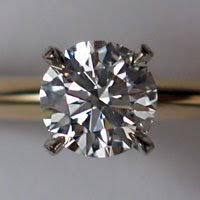
The production and distribution of diamonds is largely consolidated in the hands of a few key players, and concentrated in traditional diamond trading centers. The most important being Antwerp, where 80% of all rough diamonds, 50% of all cut diamonds and more than 50% of all rough, cut and industrial diamonds combined are handled.[citation needed] This makes Antwerp the de facto 'world diamond capital'. New York, however, along with the rest of the United States, is where almost 80% of the world's diamonds are sold, including auction sales. Also, the largest and most unusually shaped rough diamonds end up in New York. The De Beers company, as the world's largest diamond miner holds a clearly dominant position in the industry, and has done so since soon after its founding in 1888 by the British imperialist Cecil Rhodes. De Beers owns or controls a significant portion of the world's rough diamond production facilities (mines) and distribution channels for gem-quality diamonds. The company and its subsidiaries own mines that produce some 40 percent of annual world diamond production. At one time it was thought over 80 percent of the world's rough diamonds passed through the Diamond Trading Company (DTC, a subsidiary of De Beers) in London, but presently the figure is estimated at less than 50 percent.

The De Beers diamond advertising campaign is acknowledged as one of the most successful and innovative campaigns in history. N. W. Ayer & Son, the advertising firm retained by De Beers in the mid-20th century, succeeded in reviving the American diamond market and opened up new markets, even in countries where no diamond tradition had existed before. N.W. Ayer's multifaceted marketing campaign included product placement, advertising the diamond itself rather than the De Beers brand, and building associations with celebrities and royalty. This coordinated campaign has lasted decades and continues today; it is perhaps best captured by the slogan "a diamond is forever".

Further down the supply chain, members of The World Federation of Diamond Bourses (WFDB) act as a medium for wholesale diamond exchange, trading both polished and rough diamonds. The WFDB consists of independent diamond bourses in major cutting centres such as Tel Aviv, Antwerp, Johannesburg and other cities across the USA, Europe and Asia.

In 2000, the WFDB and The International Diamond Manufacturers Association established the World Diamond Council to prevent the trading of diamonds used to fund war and inhumane acts.

WFDB's additional activities also include sponsoring the World Diamond Congress every two years, as well as the establishment of the International Diamond Council (IDC) to oversee diamond grading.

Industrial diamond industry

The market for industrial-grade diamonds operates much differently from its gem-grade counterpart. Industrial diamonds are valued mostly for their hardness and heat conductivity, making many of the gemological characteristics of diamond, including clarity and color, mostly irrelevant. This helps explain why 80% of mined diamonds (equal to about 100 million carats or 20,000 kg annually), unsuitable for use as gemstones and known as bort, are destined for industrial use. In addition to mined diamonds, synthetic diamonds found industrial applications almost immediately after their invention in the 1950s; another 3 billion carats (600 metric tons) of synthetic diamond is produced annually for industrial use.

The dominant industrial use of diamond is in cutting, drilling, grinding, and polishing. Most uses of diamonds in these technologies do not require large diamonds; in fact, most diamonds that are gem-quality except for their small size, can find an industrial use. Diamonds are embedded in drill tips or saw blades, or ground into a powder for use in grinding and polishing applications. Specialized applications include use in laboratories as containment for high pressure experiments (see diamond anvil cell), high-performance bearings, and limited use in specialized windows.

With the continuing advances being made in the production of synthetic diamonds, future applications are beginning to become feasible. Garnering much excitement is the possible use of diamond as a semiconductor suitable to build microchips from, or the use of diamond as a heat sink in electronics.

Diamond supply chain

The diamond supply chain is controlled by a limited number of powerful businesses, and is also highly concentrated in a small number of locations around the world.

Mining, sources and production

Only a very small fraction of the diamond ore consists of actual diamonds. The ore is crushed, during which care has to be taken in order to prevent larger diamonds from being destroyed in this process and subsequently the particles are sorted by density. Today, diamonds are located in the diamond-rich density fraction with the help of X-ray fluorescence, after which the final sorting steps are done by hand. Before the use of X-rays became commonplace, the separation was done with grease belts; diamonds have a stronger tendency to stick to grease than the other minerals in the ore.

Historically diamonds were known to be found only in alluvial deposits in southern India.India led the world in diamond production from the time of their discovery in approximately the 9th century BCE to the mid-18th century AD, but the commercial potential of these sources had been exhausted by the late 18th century and at that time India was eclipsed by Brazil where the first non-Indian diamonds were found in 1725.

Diamond production of primary deposits (kimberlites and lamproites) only started in the 1870s after the discovery of the Diamond fields in South Africa. Production has increased over time and now an accumulated total of 4.5 billion carats have been mined since that date. Interestingly 20% of that amount has been mined in the last 5 years alone and during the last ten years 9 new mines have started production while 4 more are waiting to be opened soon. Most of these mines are located in Canada, Zimbabwe, Angola, and one in Russia.

In the US, diamonds have been found in Arkansas, Colorado, and Montana. In 2004, a startling discovery of a microscopic diamond in the US[29] led to the January 2008 bulk-sampling of kimberlite pipes in a remote part of Montana.

Today, most commercially viable diamond deposits are in Russia, Botswana, Australia and the Democratic Republic of Congo. In 2005, Russia produced almost one-fifth of the global diamond output, reports the British Geological Survey. Australia boasts the richest diamondiferous pipe with production reaching peak levels of 42 metric tons (41 LT/46 ST) per year in the 1990s.

There are also commercial deposits being actively mined in the Northwest Territories of Canada, Siberia (mostly in Yakutia territory, for example Mir pipe and Udachnaya pipe), Brazil, and in Northern and Western Australia. Diamond prospectors continue to search the globe for diamond-bearing kimberlite and lamproite pipes.


Diamond output in 2005

"Blood" diamonds

In some of the more politically unstable central African and west African countries, revolutionary groups have taken control of diamond mines, using proceeds from diamond sales to finance their operations. Diamonds sold through this process are known as conflict diamonds or blood diamonds. Major diamond trading corporations continue to fund and fuel these conflicts by doing business with armed groups. In response to public concerns that their diamond purchases were contributing to war and human rights abuses in central Africa and West Africa, the United Nations, the diamond industry and diamond-trading nations introduced the Kimberley Process in 2002, which is aimed at ensuring that conflict diamonds do not become intermixed with the diamonds not controlled by such rebel groups, by providing documentation and certification of diamond exports from producing countries to ensure that the proceeds of sale are not being used to fund criminal or revolutionary activities. Although the Kimberley Process has been moderately successful in limiting the number of conflict diamonds entering the market, conflict diamonds smuggled to market continue to persist to some degree (approx. 2–3% of diamonds traded today are possible conflict diamonds). According to the 2006 book The Heartless Stone, two major flaws still hinder the effectiveness of the Kimberley Process: the relative ease of smuggling diamonds across African borders and giving phony histories, and the violent nature of diamond mining in nations that are not in a technical state of war and whose diamonds are therefore considered "clean."

The Canadian Government has setup a body known as Canadian Diamond Code of Conductto help authenticate Canadian diamonds. This is a very stringent tracking system of diamonds and helps protect the 'conflict free' label of Canadian diamonds.

Currently, gem production totals nearly 30 million carats (6,000 kg) of cut and polished stones annually, and over 100 million carats (20,000 kg) of mined diamonds are sold for industrial use each year, as are about 100,000 kg of synthesized diamond.

List of Gems : Diamond - Surfacing & Gemological Characteristics

Surfacing

Diamond-bearing rock is brought close to the surface through deep-origin volcanic eruptions. The magma for such a volcano must originate at a depth where diamonds can be formed, 150 km (90 miles) deep or more (three times or more the depth of source magma for most volcanoes); this is a relatively rare occurrence. These typically small surface volcanic craters extend downward in formations known as volcanic pipes. The pipes contain material that was transported toward the surface by volcanic action, but was not ejected before the volcanic activity ceased. During eruption these pipes are open to the surface, resulting in open circulation; many xenoliths of surface rock and even wood and/or fossils are found in volcanic pipes. Diamond-bearing volcanic pipes are closely related to the oldest, coolest regions of continental crust (cratons). This is because cratons are very thick, and their lithospheric mantle extends to great enough depth that diamonds are stable. Not all pipes contain diamonds, and even fewer contain enough diamonds to make mining economically viable.

The magma in volcanic pipes is usually one of two characteristic types, which cool into igneous rock known as either kimberlite or lamproite. The magma itself does not contain diamond; instead, it acts as an elevator that carries deep-formed rocks (xenoliths), minerals (xenocrysts), and fluids upward. These rocks are characteristically rich in magnesium-bearing olivine, pyroxene, and amphibole minerals which are often altered to serpentine by heat and fluids during and after eruption. Certain indicator minerals typically occur within diamondiferous kimberlites and are used as mineralogic tracers by prospectors, who follow the indicator trail back to the volcanic pipe which may contain diamonds. These minerals are rich in chromium (Cr) or titanium (Ti), elements which impart bright colors to the minerals. The most common indicator minerals are chromian garnets (usually bright red Cr-pyrope, and occasionally green ugrandite-series garnets), eclogitic garnets, orange Ti-pyrope, red high-Cr spinels, dark chromite, bright green Cr-diopside, glassy green olivine, black picroilmenite, and magnetite. Kimberlite deposits are known as blue ground for the deeper serpentinized part of the deposits, or as yellow ground for the near surface smectite clay and carbonate weathered and oxidized portion.

Once diamonds have been transported to the surface by magma in a volcanic pipe, they may erode out and be distributed over a large area. A volcanic pipe containing diamonds is known as a primary source of diamonds. Secondary sources of diamonds include all areas where a significant number of diamonds, eroded out of their kimberlite or lamproite matrix, accumulate because of water or wind action. These include alluvial deposits and deposits along existing and ancient shorelines, where loose diamonds tend to accumulate because of their approximate size and density. Diamonds have also rarely been found in deposits left behind by glaciers (notably in Wisconsin and Indiana); however, in contrast to alluvial deposits, glacial deposits are not known to be of significant concentration and are therefore not viable commercial sources of diamond.


Gemological Characteristics

Diamonds are thought to have been first recognized and mined in India (Golconda being one of them), where significant alluvial deposits of the stone could then be found along the rivers Penner, Krishna and Godavari. Diamonds have been known in India for at least 3000 years but most likely 6000 years. In 1813, Humphry Davy used a lens to concentrate the rays of the sun on a diamond in an atmosphere of oxygen, and showed that the only product of the combustion was carbon dioxide, proving that diamond is composed of carbon. Later, he showed that in an atmosphere devoid of oxygen, diamond is converted to graphite. The most familiar usage of diamonds today is as gemstones used for adornment a usage which dates back into antiquity. The dispersion of white light into spectral colors, is the primary gemological characteristic of gem diamonds. In the twentieth century, experts in the field of gemology have developed methods of grading diamonds and other gemstones based on the characteristics most important to their value as a gem. Four characteristics, known informally as the four Cs, are now commonly used as the basic descriptors of diamonds: these are carat, cut, color, and clarity.

List of Gems : Diamond - Natural History

Formation

The formation of natural diamond requires very specific conditions. Diamond formation requires exposure of carbon-bearing materials to high pressure, ranging approximately between 45 and 60 kilobars, but at a comparatively low temperature range between approximately 1652–2372 °F (900–1300 °C). These conditions are known to be met in two places on Earth; in the lithospheric mantle below relatively stable continental plates, and at the site of a meteorite strike.

Diamonds formed in cratons

The conditions for diamond formation to happen in the lithospheric mantle occur at considerable depth corresponding to the aforementioned requirements of temperature and pressure. These depths are estimated to be in between 140–190 kilometers (90–120 miles) though occasionally diamonds have crystallized at depths of 300-400 km (180-250 miles) as well. The rate at which temperature changes with increasing depth into the Earth varies greatly in different parts of the Earth. In particular, under oceanic plates the temperature rises more quickly with depth, beyond the range required for diamond formation at the depth required. The correct combination of temperature and pressure is only found in the thick, ancient, and stable parts of continental plates where regions of lithosphere known as cratons exist. Long residence in the cratonic lithosphere allows diamond crystals to grow larger.


The slightly misshapen octahedral shape of this rough diamond crystal in matrix is typical of the mineral. Its lustrous faces also indicate that this crystal is from a primary deposit.

Through studies of carbon isotope ratios (similar to the methodology used in carbon dating, except with the stable isotopes C-12 and C-13), it has been shown that the carbon found in diamonds comes from both inorganic and organic sources. Some diamonds, known as harzburgitic, are formed from inorganic carbon originally found deep in the Earth's mantle. In contrast, eclogitic diamonds contain organic carbon from organic detritus that has been pushed down from the surface of the Earth's crust through subduction (see plate tectonics) before transforming into diamond. These two different source carbons have measurably different 13C:12C ratios. Diamonds that have come to the Earth's surface are generally very old, ranging from under 1 billion to 3.3 billion years old.

Diamonds occur most often as euhedral or rounded octahedra and twinned octahedra known as macles or maccles. As diamond's crystal structure has a cubic arrangement of the atoms, they have many facets that belong to a cube, octahedron, rhombicosidodecahedron, tetrakis hexahedron or disdyakis dodecahedron. The crystals can have rounded off and unexpressive edges and can be elongated. Sometimes they are found grown together or form double "twinned" crystals grown together at the surfaces of the octahedron. These different shapes and habits of the diamonds result from differing external circumstances. Diamonds (especially those with rounded crystal faces) are commonly found coated in nyf, an opaque gum-like skin.

Diamonds and meteorite impact craters

Diamonds can also form in other natural high-pressure events. Very small diamonds, known as microdiamonds or nanodiamonds, have been found in meteorite impact craters. Such impact events create shock zones of high pressure and temperature suitable for diamond formation. Impact-type microdiamonds can be used as one indicator of ancient impact craters.